Thursday, January 7, 2010

On Nonviolence in the Iranian People's Movement

Thanks to Arash Asaasi, for sending in this translation: original (in Persian) on Gozareshgaran website; initially posted at Sarbaalaayi. The writer Amin Hosoori's writings appear regularly in Khiaban newspaper, as well as on Gozareshgaran website.

On Violence in the Movement and Non-Violence
by Amin Hosoori / Monday, December 4, 2010
(translation: Arash Asaasi)


For the continuation and eventual victory of an anti-dictatorial movement, and in the face of the organized onslaught and oppression by the regime -- whose only means of survival is through the intensification of repression -- acquiring collective alacrity by the people for an 'organized defense' of each other and the movement is an undeniable necessity.

In the current opposition movement in Iran, although the need for an 'organized defense' has become obvious for some time now, unfortunately, not only has this necessity remained unanswered at the level of ideas, but, quite the reverse, in a clichéd and morphed discourse on 'nonviolent struggle' (reproduced against the backdrop of the ruling discourse), its exact opposite approach gets theorized and prescribed. Unfortunately, a superficial and incorrect understanding regarding 'nonviolent struggles' is disseminated by reformist tribunes, platforms, and individuals aligned with them. This superficial understanding prevents the growth of a collective dialogue regarding the differences between 'self-organized defense' [by the people] and 'organized onslaught' [by the regime]. In other words, this difference too, much like the above-mentioned necessity [of self-preservation of the movement], gets lost behind the 'convincing' facade of 'violence is forbidden'. In such an illusion-ridden atmosphere of 'strength of morality', in which the collective dialogue about instances of onslaught, violence and defense gets blocked, it is natural that the collective search for practical methods of preparing for 'nonviolent struggle', and creating the conditions and the preparedness among the people for consciously organizing a 'self-organized defense' is driven to the margins.

Instead, when through 'trial and error' and in a natural fashion, people from within the movement and affected by its objective and horrendous conditions, seek an answer for the above-mentioned necessity [of self-defense and preservation of the movement], a flood of accusations and theoretical falsifications flows freely: Now, the holy principles of the non-violent struggle have been violated! Item: what we witnessed in the reformist media after the bloody Ashura events [of 28 Dec. 2009]. On the other hand, although among this faction -- which has the upper hand in terms of organization and numbers of followers -- the discourse regarding the harms of the spread of violence has thickened (with emphasis on 'dangers' of the growth of radicalism), other groups and media and in opposition to the first group, praise in advance any act of (possible) violence by the people, under the pretext of 'revolutionary force'. So, in effect, the media atmosphere regarding the issue of 'violence' has turned into a slogan-ridden and impotent opposition between two polarized views: on one side stand those who, in an idealist and sentimentalist fashion and with a prescriptive outlook on the movement (with, of course, particular political interests), speechify regarding absolute negation of violence; and on the opposite side stand a few individuals and trends who, under the banner of political radicalism (1) and revolutionary behavior, believe that the violence of the regime must be answered by an equivalent violence, as they consider this a necessity for a revolutionary act. Fortunately, the media atmosphere is not bereft of critical and moderate outlooks; although these judgments have not yet been able to reduce the weight of the black-and-white outlooks in a noticeable way (2).

But, the events of the day of Ashura (bloody Sunday) can also be re-read from another viewpoint:

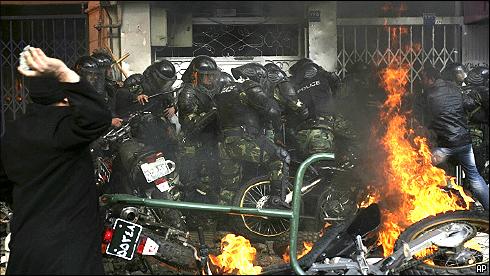
With the passing of several months from the start of the oppositional and justice-seeking movement of the people, the regime -- instead of recognizing the legitimacy of the protests and accepting the people's just demands -- at the same time that it denies the existence of the movement (3), has resorted to an ever increasingly violent crackdown against the dissidents (4). As a matter of fact, in their self-made quagmire there is no choice or tool left for the Islamic Republic but naked oppression and militarism. The continuation of the current conditions has led to a situation whereby the people, in order to guard and maintain their movement, must resort to standing up ever more powerfully in the streets. In the events of the day of Ashura, despite the immensity of the repression, people displayed unparalleled courage and resistance, and elevated the movement to a higher level of self-confidence and determination. At the same time, some people, in the process of defending themselves and resisting the blind onslaught of the paid thugs and the anti-riot police, or else affected by the limitless cruelties of the oppressive forces, in unexpected confrontations and battles, in a natural and purely emotional reaction (without any prior plans or preparation; meaning, unlike the methods used by regime's repression), committed certain acts of violence [...]. This took place -- as witnessed/recorded by video clips -- while simultaneously accompanied by a bigger number of people who were encouraging the rage-filled people to avoid violence, to calm down, and were attempting to stop the continuation of their extremist acts. But, in the end and after the publication of the news and images of the people's resistance, people like Mas'ood Behnood (5) and others -- who have been responsible for the spread of that superficial understanding of 'nonviolent struggle' -- turned some of these scenes of the youth losing their cool in the heat of the moment into excuses to moan, "We lost!" And others, like Ezatollah Sahaabi, then joined along the songs of lament (6). Without ever seeing the overall totality of the people's movement and their collective, sensible behavior on this day as contrasted to those exceptional moments; without ever mentioning a word about the systematic violence and the unbounded oppression of the regime on this day and the differences between systematic and organized violence and scattered instances of violence in [reaction to] the moment.

Yes indeed, 'they' were defeated. But not the movement! 'They' were defeated because they could not impose their own subjective picture on the reality, and this defeat was of course fully predictable because they are incapable of understanding that a movement that stands up against a dictatorial system that is oppressive to the hilt, whether you like it or not, needs ways and methods to defend itself. Such means and methods should be formulated and written down, and must lead to defensive organizing. Otherwise, the people themselves through trial and error, and of course at a higher cost, will seek and find such methods, and in all this, the occurrence of 'disagreeable' and 'immoral' scenes, regardless of the demands of 'others', will be inevitable. 'They' were defeated because you cannot transform the internal dynamics of a movement by resorting to prescriptions and by injecting it with prudent and expedient exhortations. But, the defeat of these self-assigned analysts and prescription pushers for the movement have not ended there: instead of learning a lesson from reality and revising their incorrect understanding, they view reality as being in the wrong and issue orders for the annulment of the movement (in case it transgresses those drawn borders). (Of course, 'incorrect understanding' can be corrected only in so far as it is not connected to particular political interests.) For the people, however, the survival of this movement and keeping it alive in the face of an all-out repression by the regime takes primacy over any subjective theorizing, since the people feel the justness of this movement and the need for its continuation with their flesh and skin.

With regards to the contradictions of the reformist reading of the nonviolent movement, it must be said that in cases where a part of 'truth' is presented as the whole truth, the appearance of such contradictions is inevitable. Everybody knows that the practical and theoretical founder of 'nonviolent struggle' (satyagraha), in grand socio-political movements, was Mahatma Gandhi. A part of Gandhi's success was also due to the principle of 'negation of suffering' in Hindu and Buddhist doctrines. But, do you know the limits and boundaries of the strategy envisioned by Gandhi, which was a reflection of the experiences of the revolutionary liberation movement in India?! How about the managers of the reformist media? Do they know the boundaries and the instances of 'avoiding violence'?! In a collection of Gandhi's reflections in the book All Men Are Brothers, translated [into Persian] by Mahmood Tafazoli, Gandhi is asked a question regarding this very issue: Where is the true place of 'collective defense' in the nonviolent path (during public protests and gatherings and in confrontations with the enemy's violent offensive)? Gandhi's unwavering answer was based on the necessity of collective defense in the face of an attack; with the explanation that a lack of a consistent defense in the face of attackers will weaken the movement. (On the one hand [this leads to] collective dread and fear, and on the other to unfettered mutual violence.) Gandhi correctly explains that 'violence-less struggle' does not mean acting passively. In other words, anything that can increase the courage and the morale of the resistance, and, in contrast, weaken the morale of the attackers and the rulers, is a necessity (7).

Naturally, at the current juncture, learning lessons from the path opened up by Gandhi on the trail of a universal political struggle (alongside the experiences of struggle in other countries), is necessary for the qualitative growth of the struggle and the consolidation and deepening of the movement. But this does not mean accepting wholesale the one-sided and biased interpretations that are reproduced by [reformist] media chains; on the contrary, we must critique any insistence of such interpretations, particularly in the light of the background history of the commentators and the current realities facing the movement.

To get a little more precise in this regard:

1. What are the objective instances of violence? Does violence only refer to a physical act, or can a legal code or an institutional normality too be an instance of violence? Can a law supporting capital punishment, an eye for an eye, be an instance of violence? In that case, why do those claiming to be against violence have not condemned all the executions in recent months, and in principle have not opposed capital punishment? And, on the subject of Islamic laws that are the backbone of the violence-prone authority of patriarchy in the family, why have they remained silent? Why do they still insist on political dominance of Shiite religion or political Islam, which theorizes and worships violence by theorizing it in legitimized religious clothing?

2. What is the existing proportion/ration between the organized violence of the regime in the course of the crackdowns and the scattered and in-the-moment violence of the protesters? What distinguishes these two from each other? Is any defensive reaction that appears in a physical form an instance of violence? For example, is throwing stones by protesters -- in order to prevent the advance, or an assault, by the repressive forces -- violence? (If so, the reformist circles could have accused the movement of acting violently many months earlier, as well.) Are disarming armed attackers and opening fire on the attackers (with firearms) the same and of the same weight?

3. How far do the boundaries of 'collective nonviolent defense' stretch, and what characteristics distinguish them from 'organized violent assault'? If, in the course of a movement, people come to see and feel the necessity of collective self-defense in order to safeguard themselves and to continue their movement, are the outcomes of this movement and a new society that comes out of it by necessity based on violence? Will the laws and norms of that society by necessity be violence-prone? For example, can we not expect to see in that society the passage of a law abolishing death penalty?

4. What are the real reasons for the regime's reformists resorting to a particular reading of 'nonviolence'? Has there occurred a fundamental change in their beliefs regarding the greatness of human beings and the ways of safeguarding it? (If so, why has this change of heart not included all instances of violence and, along the same lines, why has it not been followed by a critical re-reading of the past?) Or might they be viewing nonviolence as a tactical principle for the advancement and success of the movement? If so, it must be asked, is the goal of insistence on this tactic the growth and spreading of the movement, or is the goal to control the boundaries of the movement?

5. If the emphasis on nonviolence is done with the aim of preserving the movement, naturally in pursuing such an aim, creating and safeguarding self-confidence and self-belief among the movement's activists is also an inevitable necessity; a necessity that of course has its own particular methods and tactics: from a call to organized self-defense in the face of an assault, to symbolic and limited public strikes. The question here is why have the reformists as of yet evaded both these significantly important methods?

6. After the movement took up an approach based on self-preservation and spreading of the movement, if it steps into a new realm of self-confidence, self-belief and independence, can we think that, "Not only will the maintenance of the regime be more difficult now, but the hegemony of the reformists over the demands and the direction of the movement too will be jeopardized"? From this vantage point, which part of the events of the day of Ashura worries the 'nonviolent advocates' more: That the people have been sullied with violence? That the slogans expanded to include anti-system ones? Or, that the direction of the movement is toward self-organization and self-reliance? (Maybe this is the reason why Moussavi and his friends, in their 17th statement, have tried to portray and consolidate the growing stature of the movement within limited forms and demands, before it is too late!)

7. If it is true that in the media chains of the reformists radicalism parallels revolutionary behavior, and being revolutionary is the same as being violent and thinking violently, can we conclude that their aim in pursuing 'nonviolence' is not the essence of this approach, but to portray this approach as being one and the same as reformism? In other words, to gain legitimacy by tactically attaching a political strategy [reformism] to a method which has historical legitimacy! Is it truly the case that 'nonviolence' defines the content of the demands and the level of the movement's goals, and that by necessity it means the dilution/reduction (and falsification) of people's necessary needs? Or is it merely a moral and collective principle utilized for a better and less costly advance toward progressive social demands (8)? Just because a moral approach (nonviolence) has legitimacy, would it be a moral act to utilize this to eliminate other forces involved in the movement and to render the movement into one with only one voice?

8. If the people do not defend themselves in the streets, and the reformists' special interpretation of 'nonviolence' takes hold over the movement, will the regime reduce the intensity of its oppression? Will not every peaceful step taken back by the people be confronted with tens of steps of violent advance taken by the regime? Was not the silent demonstrations of the people on June 20 [2009] subjected to the bullets of the oppressors drawing blood? In principle, with the different kinds and intensities of repressive measures that we know the regime has in its portfolio (along with the lengthening of the life of the movement), by removing/eliminating the collective self-confidence/belief of the people and their hope in victory, will the situation not lead to the deterioration of the movement into increasing wear and tear and frictions [and lowered morale]?

9. By resorting to the correct statement, "We must not stumble into regime's much loved game of violence," can we deny the 'necessity of collective defense' for the preservation and continuation of the movement? To deny this, it is necessary to see 'self-defense' too as having the same value as using violence (9). What, in principle then, is the place of collective self-defense in the outlook of this hegemony-seeking [political] trend?

10. What exactly is the relationship between, on the one hand those individuals who dare speak on behalf of the green movement and on behalf of the people, compose and announce lists of movement's demands (10), and, on the other, the political trend that first equates the use of violence and radicalism, and then its spokespeople, from atop their safe places, issue orders for 'avoiding violence'? Is there not an obvious connection between this purist view of a struggle and that hegemonist view of a movement (and political affairs)?

To conclude then, the discussion regarding violence in the movement must take into account all sides and dimensions of the issue, and should not be a utilitarian and monopolistic tool aimed at achieving hegemonic goals. In my opinion, what we have seen so far regarding 'nonviolence' has more to do with a discourse oriented to power than a discourse oriented to truth and transformation.

NOTES (all references are to Persian language articles and texts):
1. Unfortunately, in our political literature, 'radicalism' too, much like 'anarchism', has been emptied of its true meaning. Especially in the recent literary movement of the reformists, with understandable reasons, radicalism has been turned into a political swear word. This is so, since, if questioning the foundations of tyranny and paying attention to the structures that produce and reproduce social injustices become epidemic, then the flowing current of the movement will be pulled in a direction contrary to the desires and ideas of the reformists. Not to forget that, on the opposite side, there are those who hide their untimely strategies and inexcusable political methods under the makeup of a claim to political radicalism.

2. Some articles that, with a critical and independent outlook on 'violence', have analyzed the issue in relation to the movement:
-- Self-Defense is not 'violence' / by Masood Noqhreh-Kaar
http://khabar.gooya.com/politics/archives/2009/12/098435.php
-- Misunderstandings Regarding Nonviolent Struggles / by Mehrdad Mashayekhi
http://www.akhbar-rooz.com/article.jsp?essayId=26225
-- Dictatorship and the Street Discourse / by Hamid Yaavari
http://www.facebook.com/note.php?note_id=251352947603&id=637939719&ref=mf

Some recent articles that resort to 'nonviolence' in order to justify the dominant political discourse:
-- I Have a Dread / by Masood Behnood
http://www.roozonline.com/persian/news/newsitem/article/////-ad1ef303f0.html
-- Violence Is the Red Line of the Green Movement / interview by Maryam Mohammadi with Ali Honari
http://www.roozonline.com/persian/interview/interview-item/article/2009/december/29//-1b5e56f6f5.html
-- Violence, Green Movement's Trap: Considerations regarding the future of the movement / by Mohammad Ebrahimi
http://www.rahesabz.net/story/6763/

3. After the events of the day of Ashura (bloody Sunday), the ruling regime once again denied the existence of the movement by using terms such as seditionists, miscreants (monafeqh; code for followers of Mojahedin Khalq Organization), communists and rioters, and other such terms, to refer to the masses of the people present on the streets, and in effect continued to consider the millions of dissident citizens as 'twigs and underbrush' [khas-o-khaashaak, as Khamenei famously called the people].

4. In the Ashura protests, at least 38 people were killed, and hundreds injured, and in its aftermath around 2,000 people were arrested. These figures, while testifying to the determination shown by the regime in oppressing the people, at any cost, at the same time indicate the weakness of the regime and their fear of the threat of collapse. It seems that the regime is currently standing on its last and final foundation.

5. I Have a Dread / by Masood Behnood
http://www.roozonline.com/persian/news/newsitem/article/////-ad1ef303f0.html

6. Letter to Fellow Citizens Living Abroad / by Ezatollah Sahaabi
http://www.rahesabz.net/story/6979/

7. Paraphrasing; unfortunately I don't have the book at the moment. [...]

8. Misunderstandings Regarding Nonviolent Struggles / by Mehrdad Mashayekhi
http://www.akhbar-rooz.com/article.jsp?essayId=26225

9. Self-Defense is not 'violence' / by Masood Noqhreh-Kaar
http://khabar.gooya.com/politics/archives/2009/12/098435.php

10. The ultimate demands of the green movement, as told by five religious intellectuals: Soroosh, Ganji, Kadivar, Mohaajerani, and Baazargaan.
http://www.rahesabz.net/story/7061/

Monday, January 4, 2010

Iran workers participation necessary for victory

From In Defense of Marxism.

Iran: The active participation of workers is necessary for final victory
Open letter to Iranian workers from Maziar Razi of the Iranian Revolutionary Marxists' Tendency
by Maziar Razi / Sunday, 03 January 2010

Honourable workers of Iran,

Today we have entered a new stage of mass activities against the threats and intimidation of the capitalist government. You have experienced the threats and suppression of the past three decades more than any other social layer. There is no social force in Iran today that has experienced the economic, psychological and moral attacks meted out by the despotic capitalist government as such as you have.[...]

Three decades ago, based on your own organisation and strength, you overthrew one of the biggest allies of US imperialism - the Shah’s regime. The strikes of workers in the big industries and factories like oil, gas, petrochemicals, steel, copper and so on, had a decisive role in overthrowing the Shah. [...] Within a few weeks you organised the biggest workers’ councils and battered down the whole apparatus of the Shah’s repressive state. [...]

It is necessary to form clandestine strike committees for general co-ordination. By co-ordinating together these committees can organise the day and time of factory strikes, and stop work together in various parts of Iran and put forward workers’ demands. You have had very significant experiences. These experiences must be used. A few years ago there were the experiences of the Baresh factory in Esfahan and Kashmir factory, and last year the protests of the workers of the Haft Tapeh factory, Kurdistan textiles and Iran Khodro factories, and so on, all of these can be put to use. [...]

Your actions will show the ways and means of anti-government struggles to the youth. In the presence of a workers’ leadership, the youth will quickly break with the reformists and move towards more radical demands. Action by you, the workers, can today bring about a different future to the present movement. Your active presence in the organisation of a general strike with the aim of defending yourself and supporting the democratic rights of millions of Iranian people is the most important action that is on the Iranian workers’ agenda today.

Victory and strength to you!
1 January 2010

Monday, December 28, 2009

Iran: Power slipping to streets

From In Defense of Marxism.

Iran: Power slipping to streets
by Babak Kasrayi
Monday, 28 December 2009

Over the last few days, mass demonstrations have erupted again in Iran. Millions are on the streets and there are reports of the people taking control of the streets, burning down police stations and even of police refusing to fire on demonstrators. These could be the last days of the hated IRI regime. If a revolutionary leadership were present, the hours of the Islamic Republic would be counted. We publish this article with lots of eyewitness reports from the ground.

A year ago it would have been impossible to believe or even think about it, but as this article goes to print, the power of Islamic Regime is being eroded in Iran and the power is slipping to streets under the massive pressure of people. The equation is simple: millions of people are on streets and there is just not enough police and military forces to contain them.

December 26 and 27 this year was concurrent with the traditional Shiite days of mourning, Tasoa and Ashoora. Shiite Muslims traditionally mourn on these days to commemorate Imam Hossein, a grandson of Prophet Mohammad, who was killed on “Ashoora”. However, like any other religious tradition it has been generally treated like a street carnival by masses. This year, in the midst of a revolutionary movement that started six months ago and has shook Iranian society to its foundations, people had decided to use it as a day of protests. It was therefore for some time generally acknowledged that December 26 and 27 will be days of massive protest.
[...]
Another very important development is some reports that show a number of forces have refused to shoot people, dismissing orders from their commanders. A report from [JRS] (Green Way Movement network), one of the most credible news sources, said:
“ [JRS] correspondent reports that clashes all over Tehran are intensifying and police has lost control of many neighborhoods. Military commanders have asked their forces in central Tehran to use direct shooting to disperse demonstrators. But forces are refusing the command, causing disputes between forces and commanders.”
A [JRS] correspondent present around Enqelab Square clashes says: “After this dispute, one of the guards said: ‘I will never kill the people of my own country’, he was then slapped by his commander who threatened him with martial court.” (Special Guard Forces Refuse to Shoot People).

Read the complete report here ...

Monday, December 14, 2009

Iran: Students Protest with Detainees' Families

Translation of a report from Pezhvak website. Read the original in Persian - plus a list of 19 additional names of the detainees of the Student Day protests - here.

Students Support Protests by Detainees' Families
Pezhvak; Monday, December 14, 2009

According to reports received by Human Rights and Democracy Activists in Iran, the families of those arrested on 16 Azar / Dec. 7 [Student Day] held a gathering in front of the Revolutionary Court building [in Tehran], to protest the arrests of their loved ones and to demand their immediate and unconditional release.

On Monday, December 14, from 9:00 AM, more than 150 people, families of the detainees, most of whose relatives were arrested on December 7, gathered in protest in front of the Revolution Court to demand that their relatives' legal situations and whereabouts be made clear.

The Ministry of Intelligence, much like years past, in order to fabricate evidence against the students who were arrested before Student Day (Dec. 7) - in assaults by intelligence security forces against them in their homes and dormitories - in all the arrest warrants/papers has recorded their day of arrest as December 8th.

The detainees' families voiced particular protest over this action of the ministry, but the only response given by the Revolution Court's staff was, "This is of no concern to us, and if you have any complaints, take it to the investigating branch to which the files have been transferred," which meant that there was as usual no accounting for anybody. In the arrest papers of all the detainees the charges are indicated as 'acting against national security'.

All the families were outraged over the continued detention and lack of any news from their loved ones, and were cursing Khamenei and Ahmadinejad.

A group of students participated in the gathering in front of the Revolution Court, in solidarity with their arrested friends and in support of the detainees' families. They announced that they would continue their protests alongside the families of the detainees until all those under arrest are freed.
[...]
[Source: Human Rights and Democracy Activists in Iran]

Friday, December 11, 2009

Stop the Execution of Zeinab Jalalian, Kurdish Activist

Dear Human Right Organisations,

My name is Ms Zeinab Jalalian (زینب جلالیان). I am a 27-year old Kurdish female political prisoner, in Iran. My Death sentenced was confirmed by Iranian Supreme Court. I am currently ill because of torture, and I don’t have a lawyer to defend me. I want to tell you that my trial took only a few minutes. The Court told me: “You are God's enemy and you must be hanged very soon.” That was all my court procedures.

I asked the judge to give me permission to hear the voice of my mother and say goodbye to my family before my execution, but he told me "Shut your mouth," and he rejected my request.

Zeinab Jalalian (زینب جلالیان)
26/11/2009
اسم من زینب جلالیان می باشد
من دختر 27 ساله‌ی کورد زندانی سیاسی ایران هستم حکم اعدام من از طرف شورای عالی دادگاه‌ انقلاب اسلامی تایید شوده‌ است ، من بخاطر شکنجه‌ی زیاد در حال حاضر مریض ، و هیچ وکیلی ندارم که‌ از من دفاع کند محاکمه‌ی من فقد چند دقیقه‌ طول کشید و ان هم این بود که‌ دادگاه‌ به‌ من گفت تو دوشمن خدا هستی و باید اعدام شوی من از حاکم خواستم که‌ پیش از اعدامم به‌ من اجازه‌ بدهد برای اخرین بار صدای مادرم و فامیلم را بشنوم حاکم از من خواست که‌ دهنم را ببندم و در خواست مرا رد کرد .
26/11/2009 زینب جلالیان
Please Write/Phone/Fax:
Head of Iran's Judiciary: Ayatollah Amoli Larijani: Office of the Head of Judiciary, Pasteur St., Vali Asr Avenue, south of Serah-e Jomhouri, Tehran 1316814737; Tel: +98 21 8 896 203 Fax: +98 21 879 6671 / +98 21 3 311 6567; Email: irjpr@iranjudiciary.org / larijani@dadgostary-tehran.ir
Minister of Foreign Affairs: Manouchehr Mottaki, Ministry of Foreign Affairs, Sheikh Abdolmajid Keshk-e Mesri Av, Tehran, Islamic Republic of Iran, Fax: + 98 21 390 1999, Email: matbuat@mfa.gov.ir
Permanent Mission of the Islamic Republic of Iran, Chemin du Petit-Saconnex 28, 1209 Geneva, Switzerland, Fax: +41 22 7330203, Email: mission.iran@ties.itu.int

Thursday, December 10, 2009

Iran Unrest Persists in Universities


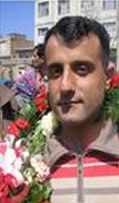
Translation of a report from the website, Rooz. See the original here. (right photo: Majid Tavakoli)

Unrest Persists in Universities
In reaction to the arrests and fabrications against Tavakoli
By Saamnaak Agha'ie (Rooz Online; Dec. 10, 2009)

In the aftermath of the arrest of Majid Tavakoli, member of Islamic Association, in Polytechnique University (Amir Kabir), and the reports by government owned media regarding his arrest 'while dressed as a woman', the universities still have a tense atmosphere and the protests against the government continue.

According to received reports, in addition to protests in Tehran's universities, yesterday also saw student gatherings in state and private universities in Mashhad, Qhazvin, Karaj, Esfahan and Shiraz. Yesterday's university student protests in several different cities followed the lie mongering by the government, and publication on websites connected to the security-intelligence forces of photos related to Majid Tavakoli, a well known student activist. Yesterday's continued [nationwide] student protests were also held in undivided solidarity with that student activist.

In this relation, the Islamic Association of the Polytechnique University, in a statement, emphasized: "Not only Majid Tavakoli, but all students in the dungeons of tyranny, are the pride of the student movement, whether they be dressed in women's clothing or men's."

Majid Tavakoli and a Speech
Majid Tavakoli, who was arrested in the assault by the security forces and the basijis on the Student Day ceremonies in Polytechnique University, is among well known student activists that in recent years has also been imprisoned [...] and has [already] suffered through a fifteen-month sentence under torture. On this year's Student Day/16 Azar, he attended the ceremonies at Polytechnique along with hundreds of other protesting students, and gave a speech for some minutes. In his speech, which was met with great enthusiasm among students, this student activist, pointing to the recent events after the elections, and pointing to the crackdown and all the spilled blood and the rapes in prisons, he emphasized the importance of students' resistance and struggle alongside the people and against the ruling despotism.

[Majid Tavakoli], in another part of his speech reminded that the Student Day is the day of shouting at tyranny, and, addressing the students, said: "In honoring and respecting a people who have risen with peaceful protests against oppression and the blood-letting, and who have today come to our support, it is our duty to be present at the gates of the university and to thank the people present in front of the university, and to strengthen our unity with the people."

Defending Imprisoned Students
Student sources believe that Tavakoli's arrest and the [lie mongering] campaign by websites supporting the coup regime was mainly due to his spirited and moving speech at the students' gathering. Yesterday, after Majid Tavakoli's arrest, [state owned] Fars News Agency initially published a photo of Tavakoli, claiming that he was arrested while dressed as a woman and trying to escape from the university.

In response to the fabrications against an arrested fellow affiliate, the Islamic Association of the Polytechnique University, in a harsh statement said: "Those who cannot stand the freedom seeking surge of the Amir Kabir students, much like in the past, scheme to destroy the dignities of free people. But, they should know that freedom belongs to those people who put themselves in danger for freedom. And in truth, Majid Tavakoli ... is such a free soul, who is always in the hearts of, and subject of talk among, the Amir Kabir University students. Iranian dictatorship must be very angry with Majid Tavakoli's words and criticisms regarding the current dictatorship in the country, since they find themselves being like the king whose nakedness has been revealed by the students. And now, hapless and helpless in understanding the students' clear slogans, they show their revenge and hatred by persecuting Majid Tavakoli. The widespread and glorious resistance of the students across the country has gotten the inept despots so confused that they could not find anything else to do other than to put some fake clothes on Tavakoli and publish the pictures. Little do they know that Majid Tavakoli has been, is and will be the pride of the students' movement, be he dressed in women's clothing or men's."

Widespread Arrests in Mashhad University
Yesterday's student protests in universities in several cities in the country were accompanied with widespread arrests. The gathering at the Ferdowsi University in Mashhad [in the northeast], protesting against the continued arrests of students on December 7th/Student Day, was for the second time faced with an assault by the security forces and the Basijis, resulting in physical beatings by security forces and arrests of at least 70 students in that university.

One of the students, in an interview with Rooz (roozonline.com), said: "This gathering was held with more than 2,000 university students attending, in front of the amphitheater's doors. Students were protesting, holding green flags and symbols, raising slogans like, "Ahoy, irreverent Karroubi, break the big statue-god" (Karroubi-e bot-shekan, bott-e bozorg-o beshkan!), and "Death to dictator!" when a group of some forty Basijis started attacking the students."

The student then continued: "When the Basijis faced resistance and the students fought back, and when the cultural deputy of the university's warnings were ineffective in ending the gathering, a large number of security forces entered the area of the gathering and along with the Basijis proceeded to assault and arrest the students."

In closing, the student pointed to the later release of some of the 70 arrested students, some hours later, and said: "But, in particular, the fate of some 13 -- who are among the more active students of the university -- remains unknown. A large number of students have announced in a statement that, in case the detained are not immediately released, they will continue to assemble and protest tomorrow as well."

Increase in the Number of Arrested Students
While the students in universities in Tehran, Shiraz, Esfahan, and may other cities in the country are determined to continue their protests in universities, news sources are reporting a rise in the numbers of arrested students in the last two days. The increase in the reports of arrested students takes place in a situation that, according to law enforcement officials, in Tehran alone more than 200 students were arrested on 16 Azar/Dec. 7. Until now, no reliable figures have been published regarding detained students in cities such as Tabriz, Hamedan, Ahvaz, Esfahan and Karaj.

In Shiraz, with the arrests of two more students, Sa'id Aganji and Razieh Ja'fari, the number of arrested students in the last two days now stands at 8. Amir Kabir Newsletter, writing about this, said: "On 16 Azar/Student Day, six students activists in Shiraz were arrested, with the following names: Seyed Mohammad Mohsen Moussavi, Sobhan Heydari, Najmaa Ranjbar, Seyed Mohammad Hosseini, Sa'id Lotfi, and Masood Mahdavi-far. In all, since 13 Aban/Nov. 4, more than 30 dissident students have been arrested in Shiraz, about whose fates and conditions no news has been available until now."

In Tehran also, with the continuation of the protests and the arrests of the Student Day, news and human rights sources yesterday reported at least 8 more arrests in the last two days: Farzad Kalb'ali, Taher Dehkhar-Qharnian, Navid Soltanpoor, Mojtaba Hashemi, Niloofar Esbati, Bardia Najaar, Mehdi Belkhari and Meisam Hosseini.

Additionally, local sources in Kurdistan also published the names of 15 students arrested in Tehran and the provinces: Ahmad Esma'ili, Amanj Rahimi, Abdollah Arefi, Pakhshan Azizi, Leyla Mohammadi, Sarveh Veisi, Hazhar Yusefi, Amjad Kordnejad, Nasser Ahmadi, Abas Kaka'ie, Ali-Reza Moradi and Sajad Moradi, are among the students arrested in Tehran University. Also, Edris Moloody in Baaneh, and Sohrab Karami in Ghorveh were detained and sent to prison.

Video of Qhazvin University Students

The banner held by the students reads, "University Is Alive!"

Continued Protests at Tehran and Sharif Universities

From Payvand Iran News.
(poster reads: University Is Alive!)

Protests of students at Tehran and Sharif Universities
Payvand Iran News / Dec. 10, 2009

Protests of students at Tehran and Sharif universities continued for a third day.

Despite the fact that last night, Tehran University issued and distributed an order over the campus and dormitory that banned any protests on December 9th, several students supporting the Green movement held a protest in front of the faculty of engineering.

According to report by Norooz News Agency, the faculty officials who wanted to show peaceful reaction to the extensive protest by the students in front of the office of Kamaree, faculty's dean, opened doors to Shahid Chamran auditorium so that students could state their objections.

After the opening of the session and a 20 minute speech by Kamaree, protesting students who were talking in the form of an open forum, repeatedly demanded resignation of Farhad Rahbar, the university's dean which was objected by Kamaree. This led to objections from the students which resulted in Kamaree leaving the auditorium.

In this session, students chanted slogans against the university security personnel. On December 7 and 8, the university security did not prevent the Basij militia, who were not students, from entering the university and beating the students inside the university, and they even assisted Basij militia to beat protesting students.

Sharif University, December 9th
According to reports, today the students of Sharif University also held a rally and protest. The arrest of at least 7 students of Sharif University and other universities including Tehran University on December 7 and 8 has been announced as the reason for this protest. Sharif University students rallied inside the university, chanted slogans and gathered in front of the university's main entrance.

Wednesday, December 9, 2009

Khiaban No. 57: Looking back at Student Day 2009

Translation of a lead article from the latest issue of Khiaban newspaper.

You can read all previous issues of Khiaban newspaper
here.

Broken Structures, Failed Repairmen
Khiaban #57 / Tuesday, December 8, 2009

16th Azar/Student Day has passed. With slogans of "Death to Khamenei!" Death to the principle of religious guardianship! "Khamenei the murderer; his guardianship null and void!" (Khamenei qhaateleh, velayatesh baateleh!) "Death to the tyrant, be it shah or the supreme leader!" (Marg bar setamgar, che shah baasheh che rahbar!) "Torture, treason; infamy on this guardianship!" (Shekanjeh, khiaanat; nang bar in velayat!) "Hossein, Hossein is your motto; raping is your peak of pride!" (Hossein, Hossein sho'aareteh, tajaavoz eftekhaareteh!). "Ahmadi has come up short, he's brought out the idiot thugs!" (Ahmadi kam aavordeh, Sha'ban bi-mokh aavordeh!). "Had there been no Basijis, Taraaneh* with us would still be!" (Agar basiji nabood, Taraaneh* peeshe maa bood!)

16th of Azar has passed. With the widespread and courageous presence of the people in the streets. People who, despite the [undeclared] military law and the military occupation of the streets, took to the streets and fought for their presence in public spaces and shouted out their demands.

16th of Azar has passed. With the announcement of the absolute will of the society to continue their movement until a free and equal society is achieved. The Student Day passed so that the society's season may begin.

They [reformists] said, and we heard, 'do not raise slogans against the system'. They said, and we heard, 'do not take to the streets; hold your ceremonies within the universities'. They said, and we heard. We heard it said by all from the reformist wing of the regime to Nehzat Azadi [Freedom Front], to the analysts outside the country, and in numerous media. From this interview and that radio, to this and that green statement.

The people, however, and the university students raised their own voices. Their own slogans. From the people's point of view, a valiye faqih [religious guardian/supreme leader] who has supervised the killings and the torture of the people, and who is the commander in chief, is a criminal. A system based on valiye faqih, which has been placed on earth by some god, and which is not accountable to anybody, cannot be defended, nor has it any room for reform. This constitution and the legal institutions are huge obstacles in the way of the actualization of the free and equal right of self-determination, to determine one's own life. The liquidation of the Revolutionary Guards and the Basij, and all the other fascistic gangs, now constitutes a demand of the people. These structures have long been shattered in the collective consciousness. The destruction of these structures and the creation of new structures that guarantee a free and equal life is now a collective demand, which cannot be silenced by media propaganda.

16th of Azar showed that those who consider themselves the leaders of the movement are not made of the same cloth as the reality of the movement. Those leaders show one strategy, but the people protesting in the streets take other steps. They advertise certain slogans, but the people protesting in the streets shout different slogans. The self-assigned spokespeople of the movement give speeches that are in contradiction to the demands raised by the people protesting.

The time has come for the people, through their own local organizations, to publish and disseminate their own voices and discourse. Issuing of statements -- reflecting demands of particular groups of citizens formed within specific networks of those who are organizing themselves -- can be the voice of the movement's depths, brought to the greater public. We must take the role of spokesman-ship back from fraudulent spokespeople. Slogans are effective but they are not enough. People must [organize to] issue statements in which they express their demands and their proposals.

[*Translator's Note: Taraaneh Mousavi, a woman who was group-raped in detention, and whose body was burned to cover up the crime.]

Tuesday, December 8, 2009

Latest from Amir Kabir Newsletter

Below, is a translation of the latest news on Amir Kabir Newsletter. The news item is about he attacks by Basij and Sepah forces against the students in Tehran and Shahid Beheshti universities. See the original here.

Also, you can see where Shahid Beheshti University is located in Tehran (facing the hills that house Evin prison), in this BBC Persian video clip, on some of the events of the Student Day in Tehran:


Revolutionary Guards and Basij Attack Tehran and Shahid Beheshti Universities
Amir Kabir Newsletter / Dec. 8, 2009

Starting this morning (Tuesday, Dec. 8), groups of Sepah (revolutionary guards) and Basijis began attacking university students in Tehran University and Shahid Beheshti University.

According to Amir Kabir Newsletter, the gates to these universities were opened by university security to Basij and Sepah forces outside the campuses, so that they could enter the grounds.

This happened after the students at Tehran University had declared yesterday that, in condemnation of the violence by the plainclothes security forces on Student Day, they would assemble to protest today, Dec. 8.

The security forces, armed with batons, truncheons and pepper sprays, went on an assault against the students. Also, based on reports from Tehran University students, a number of students were arrested and transferred out of the university.

In the meantime, this morning, several bus loads of Basij and plainclothes forces were transferred to Shahid Beheshti University to hold an assembly.

According to Amir Kabir newsletter, these forces started moving in the direction of the Shahid Beheshti University's school of law, in the process forcing the closure of classes, and proceeded to beat the students. Based on latest reports received, there is/was a confrontation between some 200 Basijis and about 300 students, exchanging slogans.

Yesterday, the students at Shahid Beheshti University celebrated and honored Student Day by holding a large and spontaneous assembly. In that assembly, the students raised radical slogans against the ruling authorities, and in front of the hills housing Evin [prison], shouted, "Allah-o Akbar!"

The Ansare Hezbollah forces and the Basijis who were bused in to Shahid Beheshti, along with the Basijis who attend the university, held an assembly in front of the men's cafeteria, and raised slogans, such as, "Moussavi kam Avordeh" (roughly, Moussavi is inept), or, "Marg bar zedde velayate faqih" (death to those opposed to religious rule of one).

In response, the university students gathered in front of women's cafeteria, and raised slogans such as, "Toop, taank, basiji; digar asar nadaarad" (canons, tanks, basijis will no longer suffice!), "Death to dictator!", and, "Get lost, Basiji!"

In view of the violence against the students by basijis and the plainclothes forces, the atmosphere there is still tense.

Free Iran Labor Leader, Pedram Nasrollahi!


Translation of statement issued by a group of labor leaders in Iran, condemning the arrest of Pedram Nasrollahi, a fellow labor leader. Original statement (in Farsi) can be read at the website of Coordinating Committee to Help Form Workers' Organization.

UPDATE: On Dec. 7th, Nasrollahi was released on a $30,000 bail, but the charges against him still stand (see the news, in Farsi, here).

Closing Statement of Ceremonies of Coordinating Committee Condemning the Arrest of Pedram Nasrollahi
December 4, 2009

Workers, organizations and institutions defending human rights, honorable and freedom loving people!

A new phase of arrests and detentions of workers and workers' rights activists has started [in Iran]. Workers' representatives of the Haft-Tapeh Sugarcane Co. syndicate were taken to jail for merely defending the workers' demands to meet their needs. The detainees of the May 1st, 2009, from Tehran were called in [by security forces] and Mohammad Ashrafi was sentenced to one year in prison. Pedram Nasrollahi, a member of Coordinating Committee to Help Form Workers' Organization, while returning home was assaulted physically, then arrested and transferred to Sanandaj prison. Threats against workers rights activists and their arrests continue. And all these under conditions, where the security and intelligence forces have been suppressing assemblies and gatherings of workers' activists, and while the oppressed and the fed-up, in order to achieve their crushed rights and demands in different social spheres take to street protests, which under the pretexts of 'disturbing the public peace' and 'fighting against national security' get crushed and their activists tried in courts with imaginary charges.

All these problems, of course, are occurring within conditions in which the working classes in Iran are facing innumerable difficulties and tragedies, under pressure from many sides and their rights denied. Capitalists don't pay their wages for months at a time and subject the workers to numerous forms of oppression and severe exploitation. At the moment, countless productive centers are faced with closures and firings and widespread unemployment continue to threaten the livelihoods of workers and their families. Also, the current government plan to supposedly 'rationalize the subsidies' [to phase out almost all subsidies _ trans. note], although not operationalized yet, has already had its psychological impact and the prices of many necessary goods have gone up, something whose pressure will be felt all the more painfully among the workers and the lower layers of the society. The continuation of these conditions will considerably worsen life and work conditions for workers, and the living conditions of the lower classes will face numerous kinds of hardships and tribulations.

It is clear that with all these hardships and restrictions, workers -- who struggle and fight for their obvious and legitimate rights -- cannot take a step backward and stop demanding their elementary and legitimate needs to be met and be given what's theirs. In the midst of all this, threats and arrests of workers and workers' rights activists will have no benefits for this exploiting class other than to expose capital's ruthlessness and to educate the masses all the more regarding the anti-worker nature of the capitalists. Such anti-workers actions and plans will only steel the will and determination of the workers for the continuation of their struggle to pursue their rights and demands in all social spheres.

We the members of Coordinating Committee to Help Form Workers' Organization, who participated in these ceremonies in defense of Pedram Nasrollahi, while condemning his arrest, demand that he be set free by the relevant authorities, and in case of the continuation of his incarceration, consider it justified to continue our efforts to free him in any form necessary and possible.

We, the participants in these ceremonies, also demand the suspension of the harassment of workers and demand the freedom of the leaders of the [Tehran] bus drivers' syndicate and the Haft-Tapeh Sugarcane Co. syndicate, and the freedom of all political prisoners.

Coordinating Committee to Help Form Workers' Organization
13 Azar, 1388 / Dec. 4, 2009


[See original in Farsi, here]